> ## Documentation Index
> Fetch the complete documentation index at: https://docs.t3planet.de/en/latest/llms.txt
> Use this file to discover all available pages before exploring further.
# AI Features
> AI Features for EXT:ns_t3af (T3AF).
## Purpose
Assign **different AI providers** per task type. Use a fast cheap model for bulk SEO work and a premium model for important pages.
\*\*Path:\*\*T3AF > AI Features
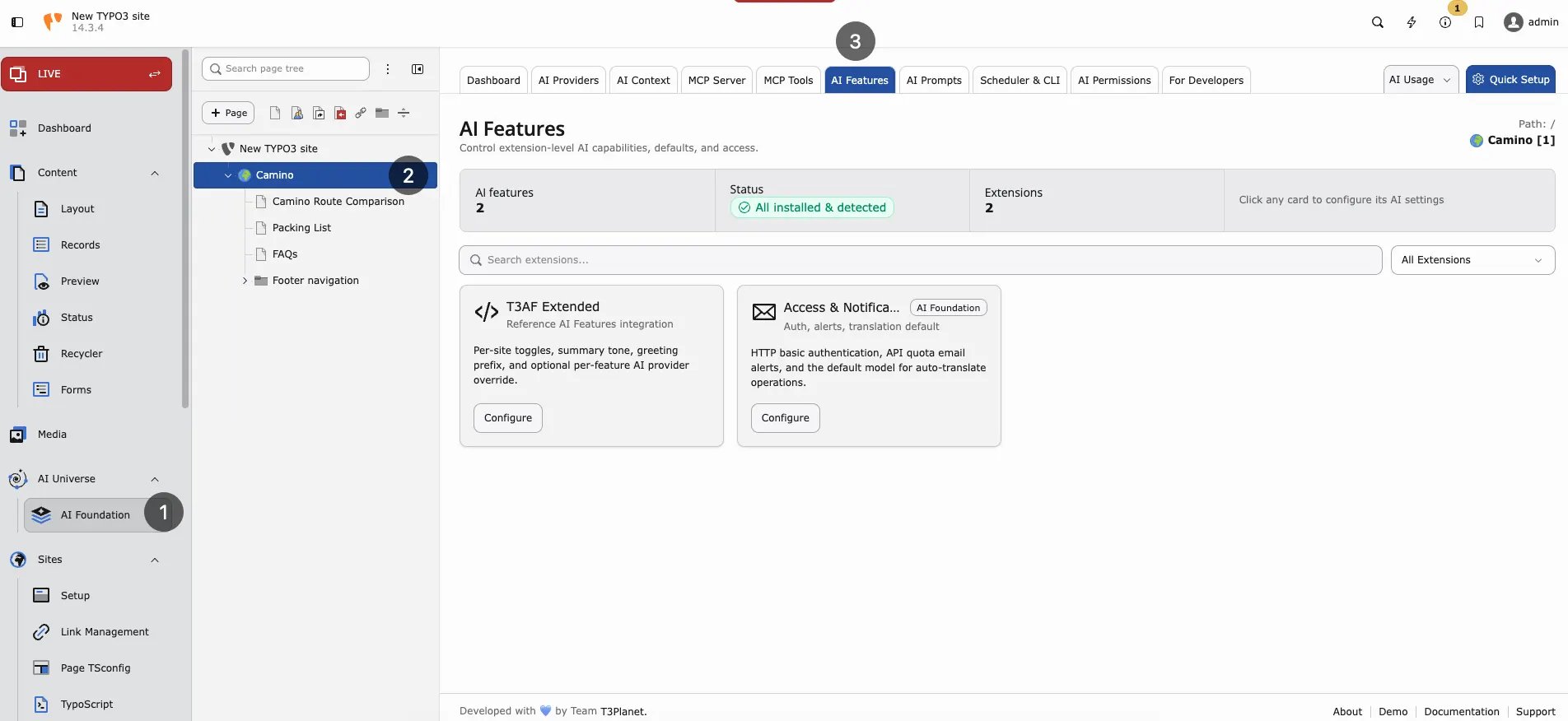 AI Features — extension cards for per-feature settings and provider overrides.
Use **AI Features** only when at least one child extension is installed. This module displays the per-feature settings that child extensions register. Examples:
* [AI Assistant](https://t3planet.de/t3ai-typo3-erweiterung)
* [AI Chatbot](https://t3planet.de/t3ac-typo3-erweiterung)
* [AI Search](https://t3planet.de/t3as-typo3-erweiterung)
* [AI Accessibility](https://t3planet.de/t3aa-typo3-erweiterung)
If no child extension is connected, the feature list stays empty or incomplete. Set a global default provider in [AI Providers](/en/latest/en/latest/ExtNsT3AF/Configuration/AIProviders/Index) first, then override providers for individual features on this page.
## Feature types
* **SEO** — Meta data, keywords, schema-related tasks
* **Pages** — Page creation and structure
* **Content** — Text generation and rewriting
* **Translation** — Language conversion
## Resolution order
When an AI request runs, T3AF picks the provider in this order:
1. Provider chosen in the UI modal (if the editor selected one)
2. **Feature default** from this page
3. **Global default** provider from [AI Providers](/en/latest/en/latest/ExtNsT3AF/Configuration/AIProviders/Index)
## When to use per-feature providers
**Small team** — Leave feature defaults empty. Use the global default only.
**Large team** — Cheap model for bulk tasks; premium model for key landing pages.
**Multilingual site** — Strong German model for Translation; fast model for SEO meta fields.
## Example setup
* **SEO** — Fast, cost-effective model (for example Gemini Flash or GPT-4o-mini)
* **Pages** — Premium model (for example Claude Sonnet or GPT-4o)
* **Content** — Balanced model for everyday editing
* **Translation** — Model strong in German and English
## Why this matters for cost
Without per-feature settings, every task uses the most expensive default. Routing SEO meta generation to a smaller model can cut monthly spend significantly while keeping premium quality where it counts.
## How to configure
1. Open T3AF > AI Features
2. For each feature row, select a provider (or leave empty for global default)
3. Save
4. Test one request per feature type from a connected extension
5. Review token usage in [AI Usage & Logs](/en/latest/en/latest/ExtNsT3AF/Configuration/AIUsageAndLogs/Index)
## Scenario: agency with dev and live keys
Use global default for staging. On production, set SEO to a fast model and Pages to premium. Dev team keeps separate provider rows in [AI Providers](/en/latest/en/latest/ExtNsT3AF/Configuration/AIProviders/Index) with dev API keys.
AI Features — extension cards for per-feature settings and provider overrides.
Use **AI Features** only when at least one child extension is installed. This module displays the per-feature settings that child extensions register. Examples:
* [AI Assistant](https://t3planet.de/t3ai-typo3-erweiterung)
* [AI Chatbot](https://t3planet.de/t3ac-typo3-erweiterung)
* [AI Search](https://t3planet.de/t3as-typo3-erweiterung)
* [AI Accessibility](https://t3planet.de/t3aa-typo3-erweiterung)
If no child extension is connected, the feature list stays empty or incomplete. Set a global default provider in [AI Providers](/en/latest/en/latest/ExtNsT3AF/Configuration/AIProviders/Index) first, then override providers for individual features on this page.
## Feature types
* **SEO** — Meta data, keywords, schema-related tasks
* **Pages** — Page creation and structure
* **Content** — Text generation and rewriting
* **Translation** — Language conversion
## Resolution order
When an AI request runs, T3AF picks the provider in this order:
1. Provider chosen in the UI modal (if the editor selected one)
2. **Feature default** from this page
3. **Global default** provider from [AI Providers](/en/latest/en/latest/ExtNsT3AF/Configuration/AIProviders/Index)
## When to use per-feature providers
**Small team** — Leave feature defaults empty. Use the global default only.
**Large team** — Cheap model for bulk tasks; premium model for key landing pages.
**Multilingual site** — Strong German model for Translation; fast model for SEO meta fields.
## Example setup
* **SEO** — Fast, cost-effective model (for example Gemini Flash or GPT-4o-mini)
* **Pages** — Premium model (for example Claude Sonnet or GPT-4o)
* **Content** — Balanced model for everyday editing
* **Translation** — Model strong in German and English
## Why this matters for cost
Without per-feature settings, every task uses the most expensive default. Routing SEO meta generation to a smaller model can cut monthly spend significantly while keeping premium quality where it counts.
## How to configure
1. Open T3AF > AI Features
2. For each feature row, select a provider (or leave empty for global default)
3. Save
4. Test one request per feature type from a connected extension
5. Review token usage in [AI Usage & Logs](/en/latest/en/latest/ExtNsT3AF/Configuration/AIUsageAndLogs/Index)
## Scenario: agency with dev and live keys
Use global default for staging. On production, set SEO to a fast model and Pages to premium. Dev team keeps separate provider rows in [AI Providers](/en/latest/en/latest/ExtNsT3AF/Configuration/AIProviders/Index) with dev API keys.