> ## Documentation Index
> Fetch the complete documentation index at: https://docs.t3planet.de/en/latest/llms.txt
> Use this file to discover all available pages before exploring further.
# AI Permissions
> AI Permissions for EXT:ns_t3af (T3AF).
Guided setup wizard for TYPO3 backend usergroup AI permissions.
\*\*Path:\*\*T3AF > AI Permissions
Follow this interactive walkthrough, then continue with the details below.
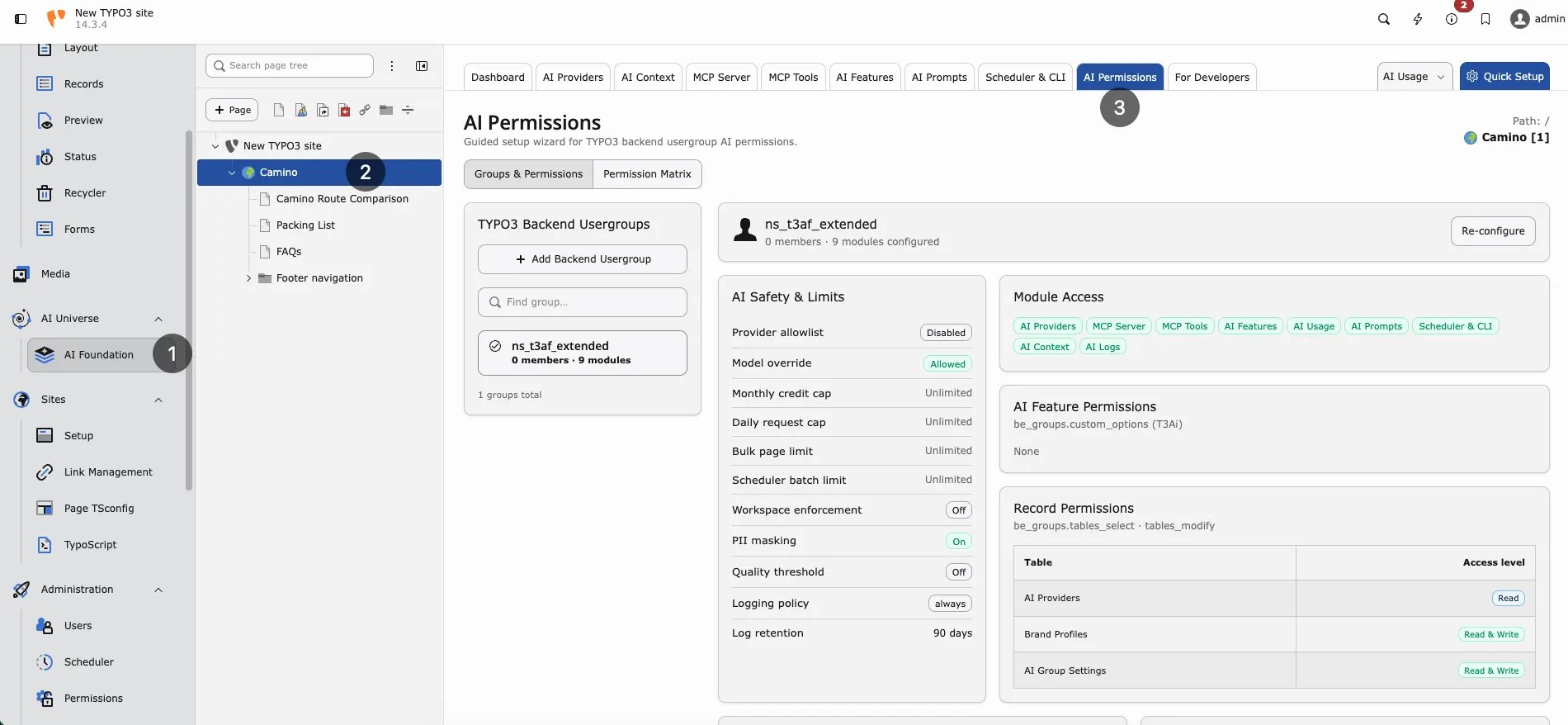 AI Permissions — configure backend usergroups and review the cross-group Permission Matrix.
Only **TYPO3 administrators** can open and change this module. Runtime enforcement still applies to every backend user.
## Purpose
Role-based access and permissions for AI on TYPO3: a guided wizard over backend usergroups so junior staff, clients, and freelancers get safe AI access without seeing admin-only tools.
Configure per group:
* **Module access** — Which T3AF tabs and child modules appear
* **Fine-grained feature permissions** — Which features inside those modules are allowed
* **Record-level restrictions** — Read vs read/write on providers, prompts, context profiles, logs, and other catalog records
* **Page-scope and batch limits** — Bulk page limits, scheduler batch limits, and workspace enforcement where enabled
* **Per-group credit limits** — Monthly credit caps and daily request caps
The module writes into normal TYPO3 backend user group ACL fields (`groupMods`, `custom_options`, `tables_select`, `tables_modify`) and merges only AI-managed keys. Unrelated modules and tables already granted to the group stay intact.
## TYPO3 Backend Usergroups
The left sidebar lists backend user groups (same shell pattern as MCP Tools).
* Search with Find group…
* Each row shows the group name, member count, and how many AI modules are configured
* Select a group to open the guided wizard for that group
Example: a group such as `ns_t3af_extended` may show `0 members` and a configured module count after you apply permissions.
## Guided wizard
After you select a group, the wizard walks through five steps:
1. **Modules** — Toggle T3AF admin modules and installed child extensions (for example AI Assistant, AI Search Hub, and other registered suite modules).
2. **Features** — Grant fine-grained feature permissions for the modules you enabled.
3. **Records** — Set record-level read or read/write access for catalog records those modules manage.
4. **Limits** — Set per-group credit limits, daily request caps, bulk/page batch limits, workspace enforcement, and audit/logging options (shown in the matrix under Credits, Workspace, and Audit).
5. **Review** — Preview the merged `be_groups` values, then apply.
Use Back / Next in the wizard footer. On Review, confirm the preview, then apply and flush caches before testing with an editor account.
## Permission Matrix
Open the **Permission Matrix** tab for a cross-group overview. The subtitle shows how many groups exist and how many are configured (for example `1 groups, 1 configured`).
### Legend
* **Use / Read / On** — Allowed (green check)
* **Mgr** — Manage / read+write
* **—** — No access
### T3AF columns
Typical matrix columns for T3AF:
* Group name and member count
* Admin modules: AI Providers, MCP Server, MCP Tools, AI Features, AI Usage, AI Prompts, Scheduler & CLI, AI Context, AI Logs
* AI Safety / limits: Credits, Workspace, Audit
Child extension scope tabs appear when those extensions register an access catalog. Unconfigured groups stay dimmed with a **Not configured** badge.
## What enforcement does
After you apply permissions:
* Restricted editors only see T3AF tabs they are allowed to use
* Dashboard may show an allowed-tabs overview instead of full analytics when usage/context/MCP tabs are closed
* AI Providers create/edit/delete needs write access on the provider table; otherwise the list stays read-only (Test connection can still work)
* Child extension tabs, cards, and mutating routes follow the same grants (403 when write is denied)
Administrators always keep full access to configure AI Permissions.
## Recommended workflow
1. Create or choose a backend user group for editors.
2. Open T3AF > AI Permissions.
3. Select the group and complete Modules → Features → Records → Limits → Review.
4. Check the **Permission Matrix** for that group.
5. Flush caches.
6. Log in as a user in that group and confirm hidden tabs and read-only screens match the matrix.
## When to use this module
* Safe AI access for junior staff, clients, and freelancers
* Editors share one instance across departments
* MCP or provider management must stay admin-only
* Per-group credit or request caps are required
* Child extensions must show only allowed tabs, features, and write actions
Developer extensions can register additional modules, features, and records through [Custom Access Catalogs](/en/latest/en/latest/ExtNsT3AF/DeveloperGuide/CustomAccessCatalogs/Index).
Product overview: [T3AF on GitHub](https://github.com/nitsan-technologies/ns_t3af).
AI Permissions — configure backend usergroups and review the cross-group Permission Matrix.
Only **TYPO3 administrators** can open and change this module. Runtime enforcement still applies to every backend user.
## Purpose
Role-based access and permissions for AI on TYPO3: a guided wizard over backend usergroups so junior staff, clients, and freelancers get safe AI access without seeing admin-only tools.
Configure per group:
* **Module access** — Which T3AF tabs and child modules appear
* **Fine-grained feature permissions** — Which features inside those modules are allowed
* **Record-level restrictions** — Read vs read/write on providers, prompts, context profiles, logs, and other catalog records
* **Page-scope and batch limits** — Bulk page limits, scheduler batch limits, and workspace enforcement where enabled
* **Per-group credit limits** — Monthly credit caps and daily request caps
The module writes into normal TYPO3 backend user group ACL fields (`groupMods`, `custom_options`, `tables_select`, `tables_modify`) and merges only AI-managed keys. Unrelated modules and tables already granted to the group stay intact.
## TYPO3 Backend Usergroups
The left sidebar lists backend user groups (same shell pattern as MCP Tools).
* Search with Find group…
* Each row shows the group name, member count, and how many AI modules are configured
* Select a group to open the guided wizard for that group
Example: a group such as `ns_t3af_extended` may show `0 members` and a configured module count after you apply permissions.
## Guided wizard
After you select a group, the wizard walks through five steps:
1. **Modules** — Toggle T3AF admin modules and installed child extensions (for example AI Assistant, AI Search Hub, and other registered suite modules).
2. **Features** — Grant fine-grained feature permissions for the modules you enabled.
3. **Records** — Set record-level read or read/write access for catalog records those modules manage.
4. **Limits** — Set per-group credit limits, daily request caps, bulk/page batch limits, workspace enforcement, and audit/logging options (shown in the matrix under Credits, Workspace, and Audit).
5. **Review** — Preview the merged `be_groups` values, then apply.
Use Back / Next in the wizard footer. On Review, confirm the preview, then apply and flush caches before testing with an editor account.
## Permission Matrix
Open the **Permission Matrix** tab for a cross-group overview. The subtitle shows how many groups exist and how many are configured (for example `1 groups, 1 configured`).
### Legend
* **Use / Read / On** — Allowed (green check)
* **Mgr** — Manage / read+write
* **—** — No access
### T3AF columns
Typical matrix columns for T3AF:
* Group name and member count
* Admin modules: AI Providers, MCP Server, MCP Tools, AI Features, AI Usage, AI Prompts, Scheduler & CLI, AI Context, AI Logs
* AI Safety / limits: Credits, Workspace, Audit
Child extension scope tabs appear when those extensions register an access catalog. Unconfigured groups stay dimmed with a **Not configured** badge.
## What enforcement does
After you apply permissions:
* Restricted editors only see T3AF tabs they are allowed to use
* Dashboard may show an allowed-tabs overview instead of full analytics when usage/context/MCP tabs are closed
* AI Providers create/edit/delete needs write access on the provider table; otherwise the list stays read-only (Test connection can still work)
* Child extension tabs, cards, and mutating routes follow the same grants (403 when write is denied)
Administrators always keep full access to configure AI Permissions.
## Recommended workflow
1. Create or choose a backend user group for editors.
2. Open T3AF > AI Permissions.
3. Select the group and complete Modules → Features → Records → Limits → Review.
4. Check the **Permission Matrix** for that group.
5. Flush caches.
6. Log in as a user in that group and confirm hidden tabs and read-only screens match the matrix.
## When to use this module
* Safe AI access for junior staff, clients, and freelancers
* Editors share one instance across departments
* MCP or provider management must stay admin-only
* Per-group credit or request caps are required
* Child extensions must show only allowed tabs, features, and write actions
Developer extensions can register additional modules, features, and records through [Custom Access Catalogs](/en/latest/en/latest/ExtNsT3AF/DeveloperGuide/CustomAccessCatalogs/Index).
Product overview: [T3AF on GitHub](https://github.com/nitsan-technologies/ns_t3af).