AI Permissions
Guided setup wizard for TYPO3 backend usergroup AI permissions.
Path: AI Foundation > AI Permissions
Follow this interactive walkthrough, then continue with the details below.
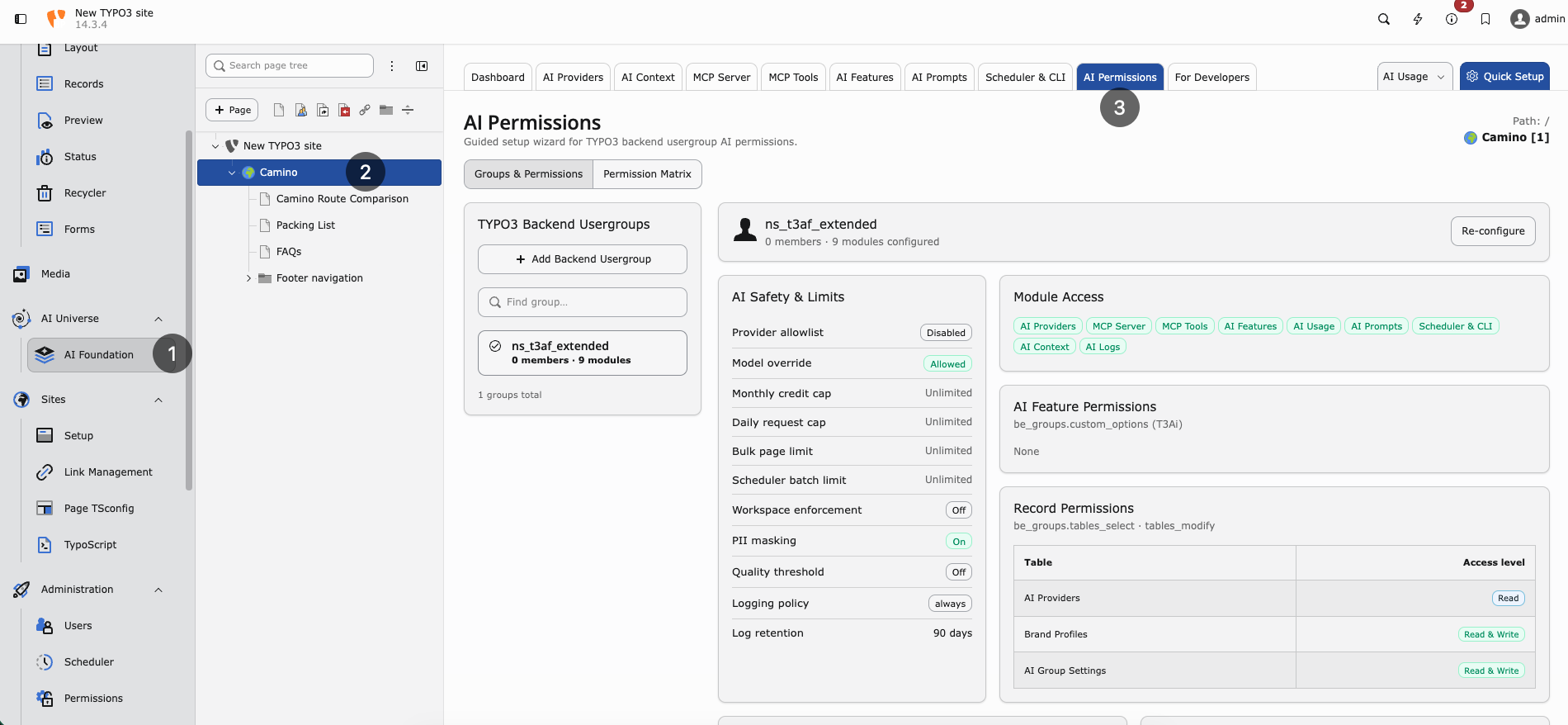
AI Permissions — configure backend usergroups and review the cross-group Permission Matrix.
Only TYPO3 administrators can open and change this module. Runtime enforcement still applies to every backend user.
Purpose
Role-based access and permissions for AI on TYPO3: a guided wizard over backend usergroups so junior staff, clients, and freelancers get safe AI access without seeing admin-only tools.
Configure per group:
Module access — Which AI Foundation tabs and child modules appear
Fine-grained feature permissions — Which features inside those modules are allowed
Record-level restrictions — Read vs read/write on providers, prompts, context profiles, logs, and other catalog records
Page-scope and batch limits — Bulk page limits, scheduler batch limits, and workspace enforcement where enabled
Per-group credit limits — Monthly credit caps and daily request caps
The module writes into normal TYPO3 backend user group ACL fields
(groupMods, custom_options, tables_select, tables_modify) and
merges only AI-managed keys. Unrelated modules and tables already granted to
the group stay intact.
TYPO3 Backend Usergroups
The left sidebar lists backend user groups (same shell pattern as MCP Tools).
Search with Find group…
Each row shows the group name, member count, and how many AI modules are configured
Select a group to open the guided wizard for that group
Example: a group such as ns_t3af_extended may show 0 members and a
configured module count after you apply permissions.
Guided wizard
After you select a group, the wizard walks through five steps:
Modules — Toggle AI Foundation admin modules and installed child extensions (for example AI Assistant, AI Search Hub, and other registered suite modules).
Features — Grant fine-grained feature permissions for the modules you enabled.
Records — Set record-level read or read/write access for catalog records those modules manage.
Limits — Set per-group credit limits, daily request caps, bulk/page batch limits, workspace enforcement, and audit/logging options (shown in the matrix under Credits, Workspace, and Audit).
Review — Preview the merged
be_groupsvalues, then apply.
Use Back / Next in the wizard footer. On Review, confirm the preview, then apply and flush caches before testing with an editor account.
Permission Matrix
Open the Permission Matrix tab for a cross-group overview. The subtitle
shows how many groups exist and how many are configured (for example
1 groups, 1 configured).
Legend
Use / Read / On — Allowed (green check)
Mgr — Manage / read+write
— — No access
AI Foundation columns
Typical matrix columns for AI Foundation:
Group name and member count
Admin modules: AI Providers, MCP Server, MCP Tools, AI Features, AI Usage, AI Prompts, Scheduler & CLI, AI Context, AI Logs
AI Safety / limits: Credits, Workspace, Audit
Child extension scope tabs appear when those extensions register an access catalog. Unconfigured groups stay dimmed with a Not configured badge.
What enforcement does
After you apply permissions:
Restricted editors only see AI Foundation tabs they are allowed to use
Dashboard may show an allowed-tabs overview instead of full analytics when usage/context/MCP tabs are closed
AI Providers create/edit/delete needs write access on the provider table; otherwise the list stays read-only (Test connection can still work)
Child extension tabs, cards, and mutating routes follow the same grants (403 when write is denied)
Administrators always keep full access to configure AI Permissions.
Recommended workflow
Create or choose a backend user group for editors.
Open AI Foundation > AI Permissions.
Select the group and complete Modules → Features → Records → Limits → Review.
Check the Permission Matrix for that group.
Flush caches.
Log in as a user in that group and confirm hidden tabs and read-only screens match the matrix.
When to use this module
Safe AI access for junior staff, clients, and freelancers
Editors share one instance across departments
MCP or provider management must stay admin-only
Per-group credit or request caps are required
Child extensions must show only allowed tabs, features, and write actions
Developer extensions can register additional modules, features, and records through Custom Access Catalogs.
Product overview: AI Foundation on GitHub.