

Purpose
Add and manage the sources of content that will be used for AI search and the AI chatbot (e.g. website pages, PDFs, Q&A).Adding a data source
- Click + Add Source.
- Choose the type of source, for example:
- Sitemap XML – Your sitemap URL(s) (e.g.
https://example.com/sitemap.xml). - PDF Documents – Folder path where PDFs are stored (and optionally upload PDFs).
- TYPO3 Pages – Content from specific TYPO3 pages.
- Web Pages – A website URL; optionally limit to a path (e.g.
https://example.com/blog/*). - Q&A Pairs – Manual question-and-answer content.
- Indexed Search / Ke Search / Solr – If the corresponding extensions are installed and indexed content is available.
- Fill in the requested details (URLs, folder path, page selection, etc.) and give the source a Name (e.g.
Main Website) and optional Description. - Set Sync interval: how often content should be refreshed (e.g. Hourly, Daily, Weekly). Custom means no automatic schedule (manual sync only).
- Set Used by (formerly Type) to control whether this source is available for AI Search, AI Chatbot, or Both.
- Set Enabled to on if the source should be active.
- Click Save.
- Create or update the data source.
- Sync content into the training queue (new or changed items).
- Automatically create the T3AF Training Scheduler task for this site (if it does not exist yet) and run it at the frequency you set (e.g. Hourly, Daily, Weekly). You do not need to create the scheduler task manually—it is created when the source is saved and will execute according to the chosen sync interval.
Editing or deleting a source
Use the actions next to each data source to edit (type, URLs, interval, usage) or delete it.Source Groups | Page-Level Source Configuration
Source Groups allow administrators and editors to organize data sources and control which content is available to AI Search and the AI Chatbot on a page-by-page basis. This gives you precise control over retrieval because only the selected Source Groups are considered for that page. Source Groups are used only during content retrieval. They do not affect AI training, vector indexing, Scheduler execution, embedding generation, or data synchronization. The filtering is applied by the VectorService during retrieval.Backend Configuration
Manage Source Groups
Go to Data Sources -> Source Groups to manage Source Groups. Administrators can:- create Source Groups
- edit Source Groups
- delete Source Groups
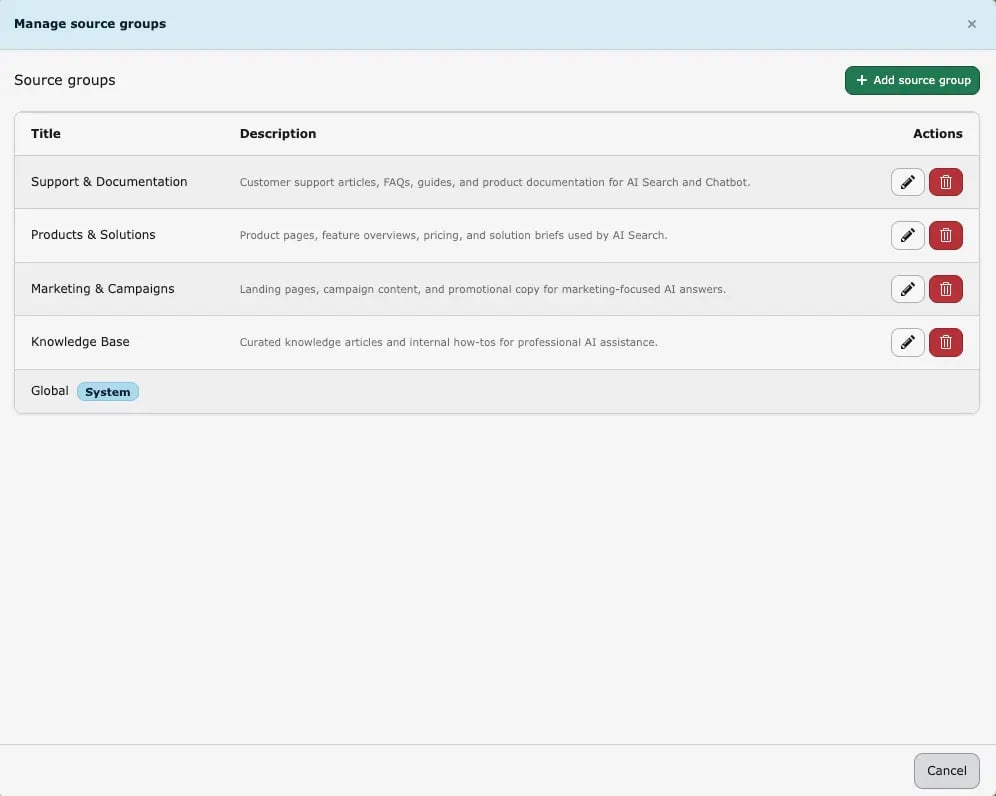
The Global Source Group is a system group and cannot be edited or deleted.
Assign Source Groups to Data Sources
When creating or editing a data source, users can:- select one or more Source Groups
- rely on the Global Source Group, which is assigned automatically
- configure the Used by field (formerly Type) to control where the source is available
- AI Search
- AI Chatbot
- Both AI Search and AI Chatbot
Page-Level Configuration (T3AS / T3AC)
- Open the desired TYPO3 page.
- Open Page Properties.
- Go to the AI Search tab.
- Find the Source groups field.
- Select the Source Groups that should be available on that page.
 Choose Source Groups under Page Properties → AI Search so AI Search and AI Chatbot use only those sources on that page.
Only data sources assigned to the selected Source Groups are used on that page and their child/recursive pages.
This filtering applies to both AI Search and AI Chatbot, and different pages can use different Source Groups.
Choose Source Groups under Page Properties → AI Search so AI Search and AI Chatbot use only those sources on that page.
Only data sources assigned to the selected Source Groups are used on that page and their child/recursive pages.
This filtering applies to both AI Search and AI Chatbot, and different pages can use different Source Groups.
Practical Example
A company has separate documentation for Products, HR, and Internal Policies. Three Source Groups are created:- Products
- HR
- Internal
Source Groups only affect content retrieval. Existing training data, embeddings, vector indexing, and scheduled synchronization continue to operate normally.
If no custom Source Groups are selected, the Global Source Group remains available according to the configured behavior.
Header / Footer for Sitemap and Web-Page Source Types
These options help you keep repeated layout content out of the main page body while still making shared site information available to chatbot and search retrieval.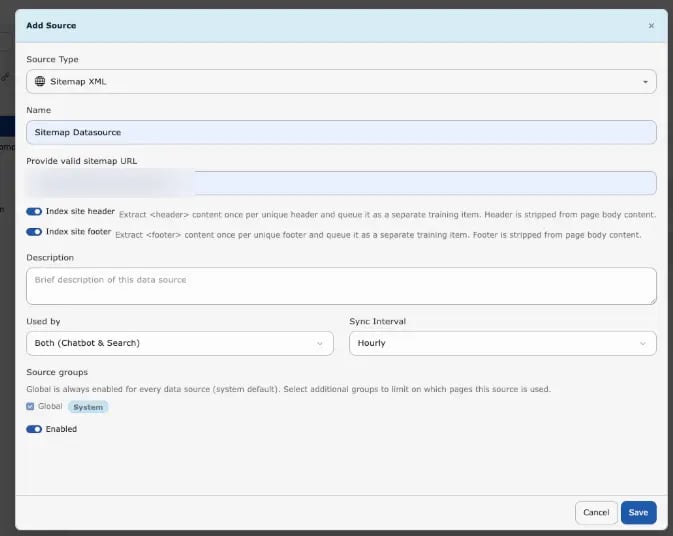
- extract the website
<header>content one time for each unique header - store that content as a separate training item
- remove the same header content from the page body before indexing
- reduces duplicate information across many pages
- keeps repeated navigation or shared header text from being indexed over and over
- preserves useful shared site information for retrieval
- when the header contains meaningful text that supports AI answers
- when many pages share the same header content
- websites with shared product navigation or service overviews in the header
- websites where the header contains reusable company or category information
- extract the website
<footer>content one time for each unique footer - store that content as a separate training item
- exclude that footer content from the page body during indexing
- prevents duplicate footer text from being trained again on every page
- keeps the main page content cleaner for retrieval
- preserves useful global site information such as company details or support links
- when the footer contains helpful shared text for chatbot or search answers
- when the same footer appears on many pages
- websites with shared contact details, policy references, or company summaries in the footer
- large sites where repeated footer content would otherwise be indexed many times
Enable Index Site Header and/or Index Site Footer in the data source form when creating or editing a Sitemap XML or Web Pages source.
Deleting a data source also removes its training queue and embedded data for that source.
Sync
Sync (per source or Sync all) refreshes content from the source into the training queue.- Sync does not run AI training by itself.
- Training is performed by the Scheduler task or manually (see Training Center).
Scheduler
T3AF Training is the shared console commandnst3af:training (AI Foundation / T3CS). It powers automatic indexing for AI Chatbot (T3AC).
When you create a data source, T3AC will automatically create the T3AF Training Scheduler task for this site (if it does not exist yet) and run it at the frequency you set (e.g. Hourly, Daily, Weekly). You do not need to create the scheduler task manually—it is created when the source is saved and will execute according to the chosen sync interval.
From the Dashboard you can open the TYPO3 Scheduler and locate the automatic training task (typically named T3AF Training for this site). Use Run All or Run Task Now to process the training queue immediately.
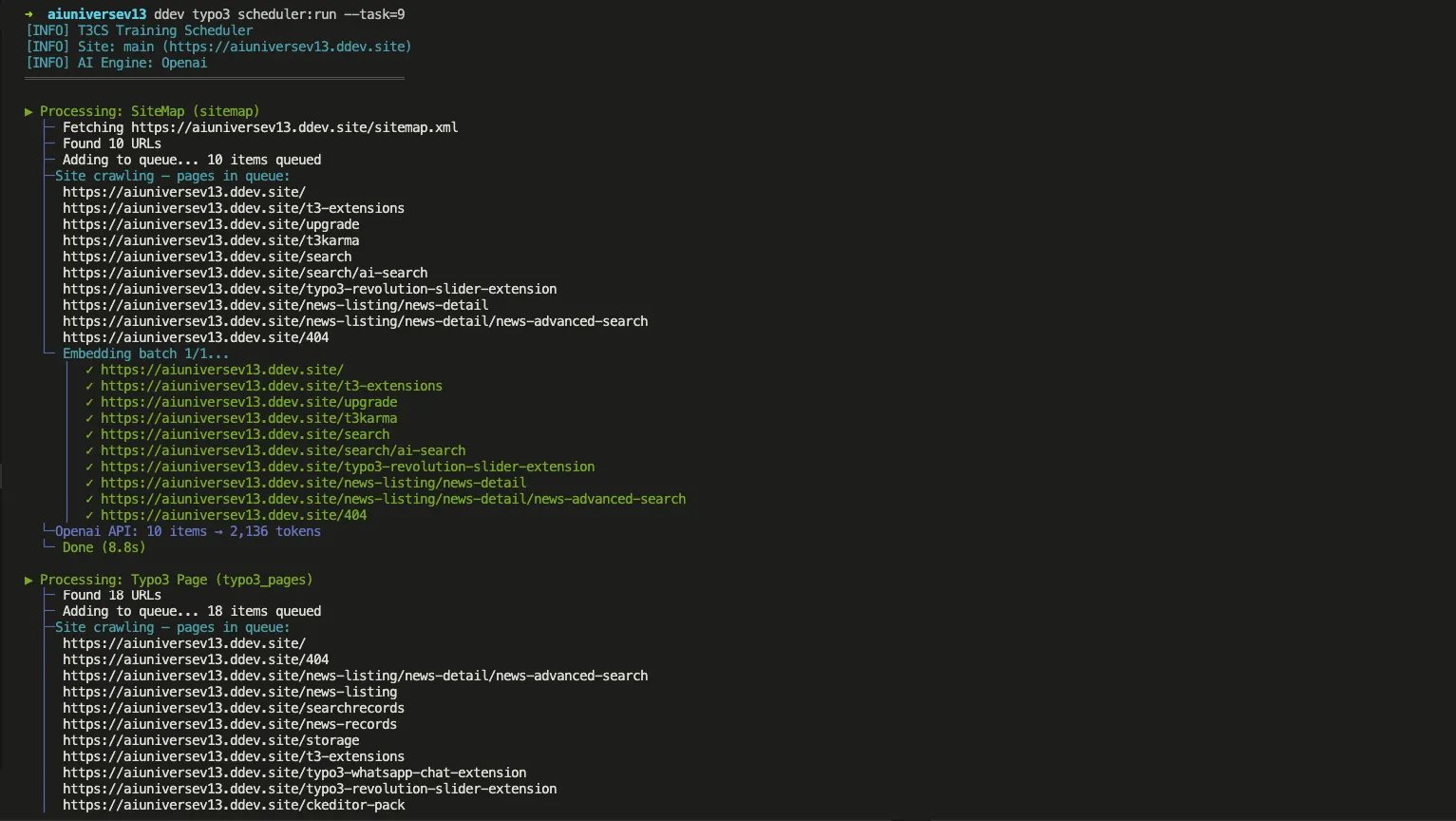
When the scheduler runs this task for a site, it:
- Syncs enabled data sources for that site (crawl or refresh content into the training queue).
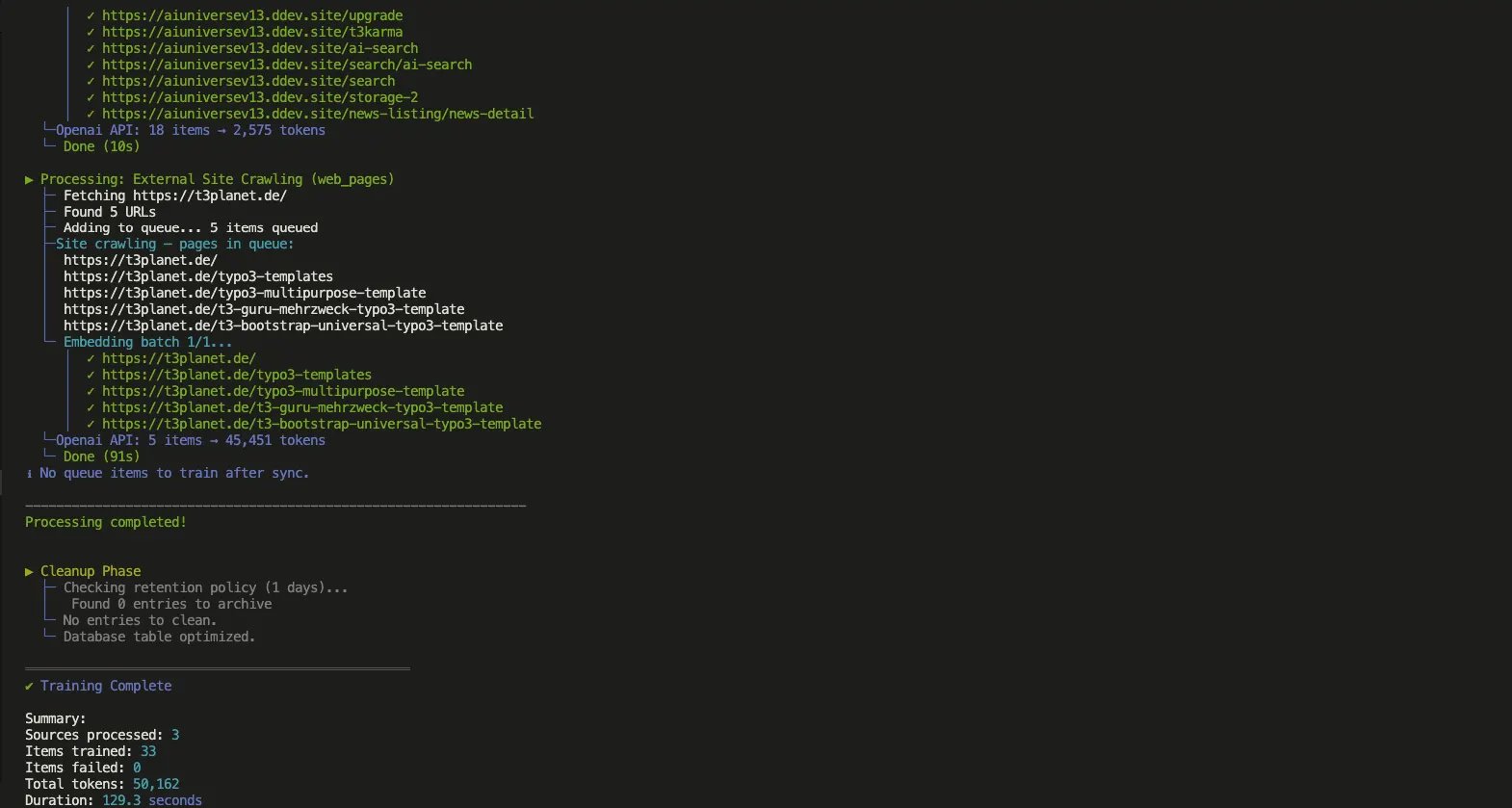
- Trains pending queue items (chunks content and generates embeddings via your configured AI provider or T3Planet Credits).
- Cleans up old completed/failed queue rows according to the retention setting (optional archive to CSV).
Sync in the Data Sources UI only marks content for refresh. It does not call the AI or create embeddings by itself. Embeddings are created when T3AF Training runs (scheduler, CLI, or Training Center actions that trigger the same pipeline).
<rootPageId> with your site root page ID and <taskUid> with the numeric UID from the Scheduler module (do not assume a fixed ID such as 9).
Argument
rootPageId (optional when using scheduler:run --task=)
Site root page ID. Required for direct CLI runs unless the scheduler passes it via the task.
Options
--source=ID
Process only one data source (must belong to the site).
--detailed
Verbose output (each URL, PDF, and similar). Enabled by default on the automatic scheduler task. It will show the detailed progress in the CLI command.
--dry-run
Preview only — no API calls and no database updates.
--limit=N
Process at most N queue items per data source.
--batch-size=N
Embedding batch size (default: extension Batch size or 100). Set on the scheduler task from extension settings when the task is created or updated.
--skip-cleanup
Skip the post-training cleanup phase.
--cleanup-only
Run cleanup only (no sync, no embedding).
--retention-days=N
Delete or archive queue rows older than N days (default: extension Retention days or 30). Set on the scheduler task from extension settings.
--no-archive
Delete old queue rows without writing a CSV archive first.
--optimize-db
Run OPTIMIZE TABLE after cleanup.
--queue-failed
Move Failed queue items back to Pending before processing.
--force / -f
Re-train all: set all queue items (completed/failed/processing) back to Pending and process.
It does not automatically set sync_requested. Sync still requires the Sync action from the DataSource tab.
What the automatic scheduler task uses
Only rootPageId, --batch-size, --retention-days, and --detailed. All other options are for manual CLI or custom scheduler tasks you create yourself.
Example commands
Composer / TYPO3 v13+ (typical):
scheduler:execute instead of scheduler:run; see TYPO3 Scheduler CLI documentation.
- Batch size →
--batch-sizeon the task - Retention days →
--retention-dayson the task - Chunk size, Max link crawl, rate limits — affect sync and embedding behavior during the run
- Log archive path (optional) — where cleanup CSV archives are stored
Command t3af:history:cleanup — history log cleanup
T3AF History Cleanup is the shared console command t3af:history:cleanup (AI Foundation / T3CS). It deletes AI Search and Chatbot usage history older than the retention period.
This is separate from training-queue cleanup (--retention-days on nst3af:training). Use it to keep Usage Analytics history within a privacy or storage limit.
If the task does not exist yet, create it in the TYPO3 Scheduler module:
- Create a new task and select Execute console commands.
- Choose
t3af:history:cleanup. - Set the days argument and the frequency on the Timing tab.
- Save the task.
days
: Retention in days before deletion. Edit this argument on the scheduler task. Default is 90 when omitted.
Example commands
Composer / TYPO3 v13+ (typical):
days to 3 deletes usage history older than 3 days (CLI: t3af:history:cleanup 3).
 Configure days on the
 t3af:history:cleanup scheduler task. Default retention is 90 days when the argument is omitted.
More options for other AI Foundation scheduler commands (MCP cleanup, and so on) are listed under AI Foundation → Scheduler & CLI in the TYPO3 backend.