

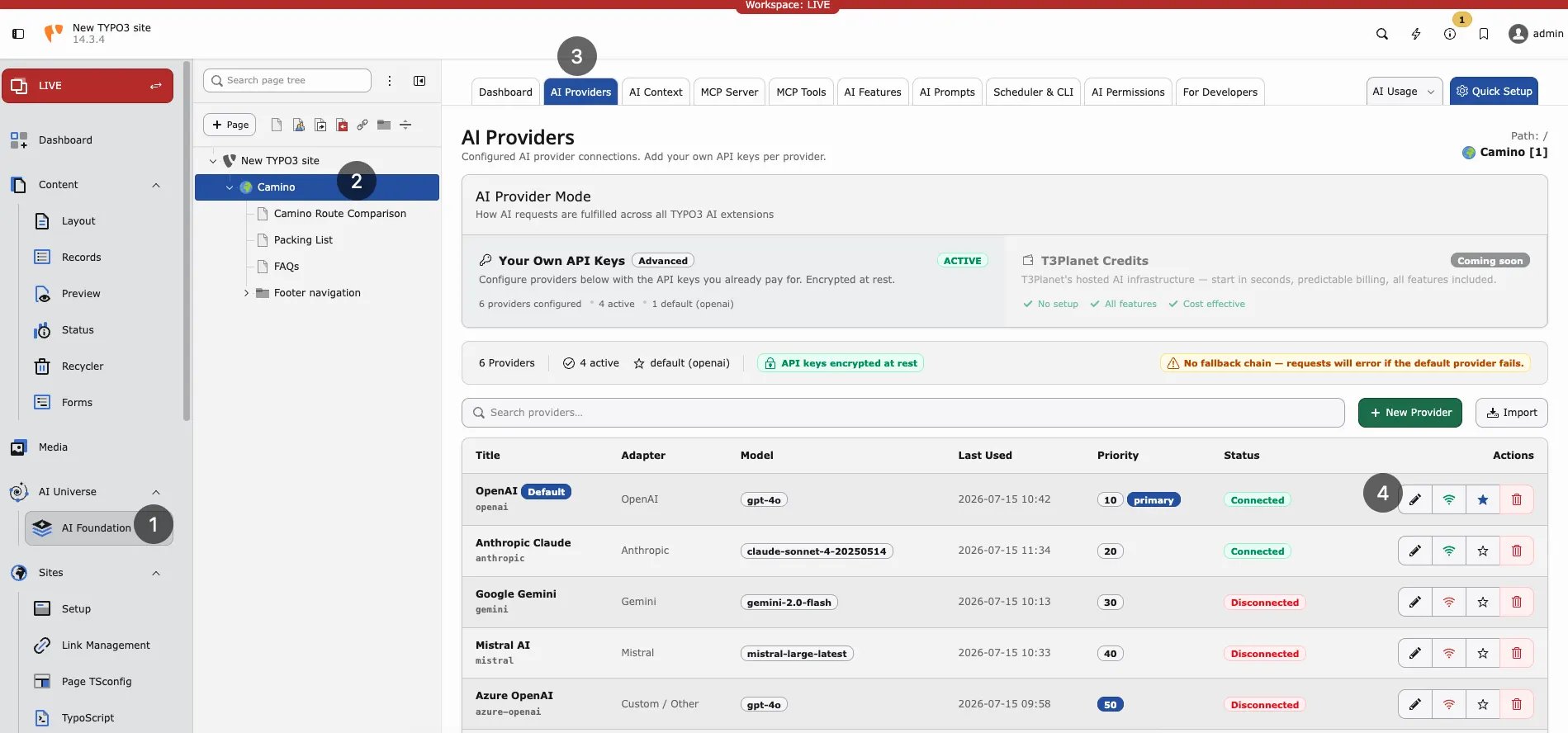
Adding a provider
- Open T3AF > AI Providers.
- Click Add provider.
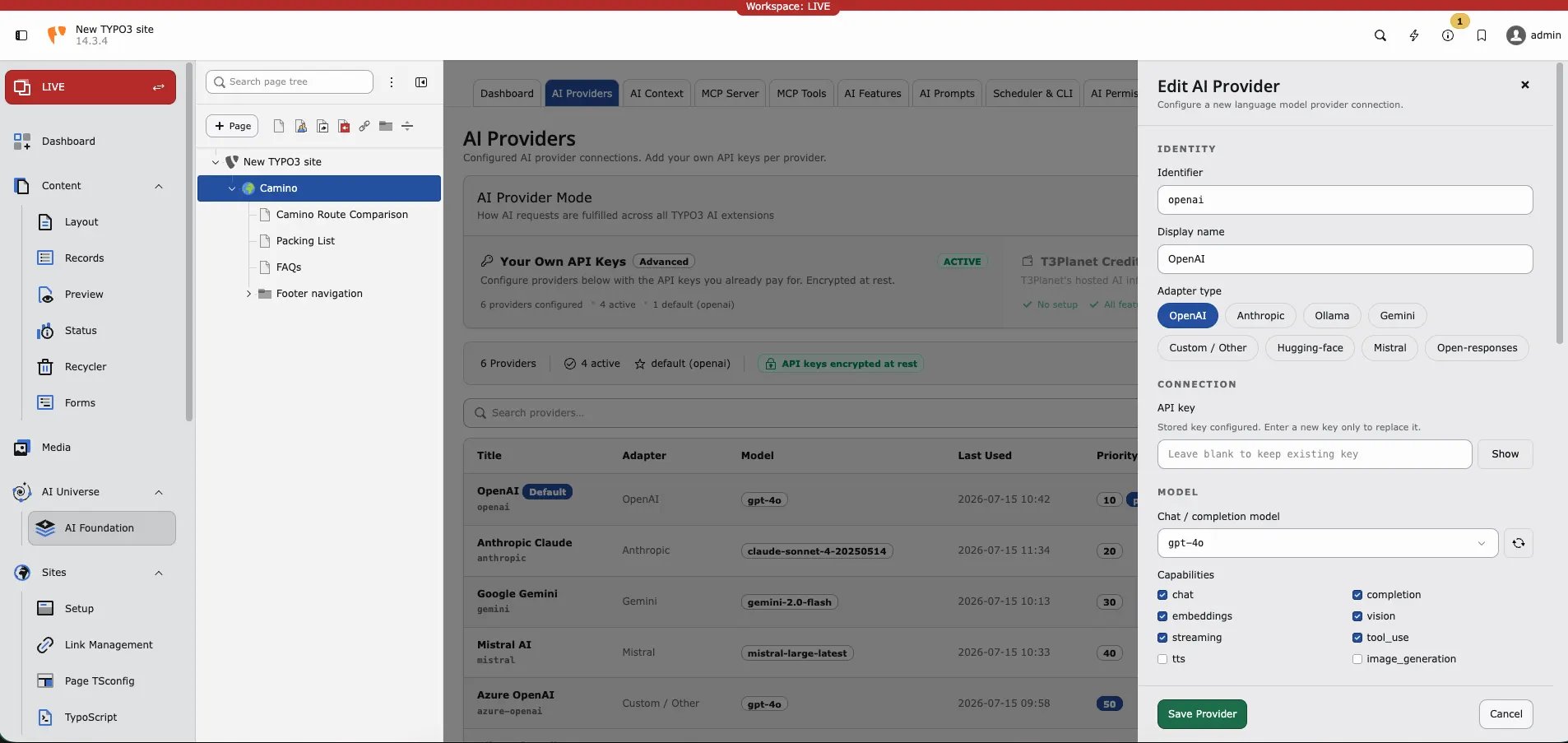
- Fill in the required fields:
- Display name — Friendly label for your team (for example
OpenAI production). - Adapter type — Vendor protocol (OpenAI, Anthropic, Gemini, Azure, Mistral, DeepSeek, xAI, Ollama, or custom OpenAI-compatible).
- API key — Cloud vendors need a key. Leave empty for local Ollama.
- Model ID — Completion model (for example
gpt-4o-mini).
- Optionally set the endpoint URL, embedding model, capabilities, temperature, and pricing fields.
- Click Save.
- Enable Default on exactly one provider.
Testing a connection
After saving a provider, click Test connection to verify the setup. The test calls the provider API and reports:- Connection status (success or failure)
- Error details on failure
- Model / capability hints when the adapter can list them
Self-hosted endpoints (such as Ollama) must be reachable from the TYPO3
server. Typical causes of a failed test:
- Wrong host or port in Endpoint URL (default
http://localhost:11434for Ollama) - Docker/network isolation between PHP and the model host
- Outbound HTTPS blocked for cloud vendors
Editing and deleting providers
- Click a provider row to edit its settings in the drawer.
- Use Test connection after rotating an API key or changing the model.
- Use Delete to remove a provider. Features that pointed at that provider fall back to the global default (or fail until another provider is assigned).
Supported adapters
Built-in and discovered adapters include:symfony.openai— OpenAIsymfony.anthropic— Anthropic Claudesymfony.gemini— Google Geminisymfony.mistral— Mistral AIsymfony.ollama— Local Ollamasymfony.openrouter— OpenRouternst3af.openai_compatible— Custom / OpenAI-compatible endpoints- Additional Symfony AI bridges when their Composer packages are installed (for example Azure, DeepSeek, xAI)
Capabilities
Pick a model that supports what you need. Test connection helps validate the choice.- Chat — Text generation
- Streaming — Live response display in the backend
- Embeddings — Search and similarity features
- Vision — Image analysis
- Tool use — MCP agent workflows
Multiple providers — when and why
Dev and live — Separate rows with different API keys per environment. Cost saving — Cheap model as global default; premium model assigned in AI Features for important tasks. EU hosting — Mistral or Azure in an EU region for data residency requirements.Provider fields
Fields below map to the AI Providers drawer and thetx_nst3af_provider table.
Required
Connection
Optional configuration
Governance and status
Optional pricing (pricing_input_per_1m, pricing_output_per_1m,
pricing_currency, cost_center), retention overrides, dashboard analytics
flags, and read-only status fields (last_status, last_status_at,
last_status_message, last_used_at) support monitoring and cost tracking.
Status fields update after Test connection and live requests.
Troubleshooting
Test fails — Check the API key, model ID, endpoint URL, and outbound HTTPS/firewall rules. Rate limit — Wait or upgrade the vendor plan. Vision returns empty — Use a vision-capable model (for example GPT-4o with vision). Module works but child extension fails — Check AI Features for per-task overrides.Security
- Rotate keys every 90 days
- Use one key per environment (dev, staging, live)
- Restrict access via AI Permissions
- Never commit API keys to Git
Where to get API keys
- OpenAI: https://platform.openai.com/api-keys
- Anthropic: https://console.anthropic.com/
- Google Gemini: https://aistudio.google.com/apikey
- Mistral: https://console.mistral.ai/
- Azure OpenAI: https://portal.azure.com/